
Enterprise Media Analytics Platform
Transforming a legacy desktop application into a scalable web platform that unifies digital, TV, radio, and outdoor media analytics.
Frontend Product Owner
Market Intelligence
Media Analytics
System Architecture
API UX
Data Visualisation
My Role & Responsibilities
Bridging design craft with frontend ownership
I navigated the entire product lifecycle - from initial discovery to defining the technical architecture. I acted as the primary bridge between the design team, customer service, and backend data engineers.
Wearing two hats as Head of Product Design and Frontend Product Owner, I not only managed the design team's priorities but also defined the frontend roadmap to ensure the interface accurately reflected complex backend data processing.
-
Product Strategy
Acted as Frontend Product Owner, defining the roadmap, prioritising features, and aligning tightly with backend stakeholders. -
Design Leadership
Managed and reviewed work for a team of product designers while staying hands-on with core interface design. -
API User Experience
Championed the API as an integral part of the product, designing its experience to serve advanced analysts natively. -
Architecture
Built reusable, simplified design patterns intended to scale across the company's entire software portfolio.
The Challenge
A single source of truth for diverse, complex data
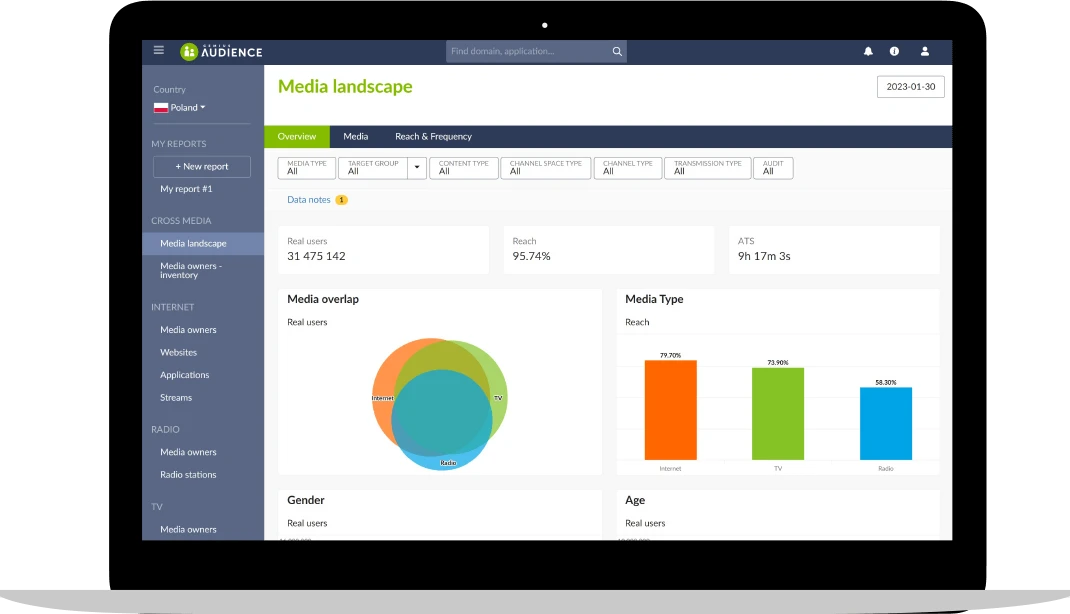
The brief was deceptively simple: migrate a legacy desktop application to the web. The reality was a highly complex market intelligence tool that needed to handle different feature scopes and data types across global markets, complete with white-label capabilities.
Furthermore, the platform introduced single-source measurement - comparing internet, TV, radio, and outdoor consumption in one tool. We faced a stark user divide: junior marketers needed guided UI education, while veteran analysts relied heavily on automation and raw data via API.
-
Legacy Migration
Translating a heavy, feature-dense desktop application into a lightweight, accessible web platform. -
The User Divide
Serving both junior marketers who needed guidance and veteran analysts who required raw data power. -
Single-Source Data
Presenting cross-media metrics (internet, TV, radio, OOH) side-by-side without overwhelming the user. -
Global Scalability
Adapting the architecture to support varying data availability and feature scopes across different international markets.
Preview
Designing for progressive complexity
To solve the user gap and the immense data density, I designed a tiered experience that educated beginners while empowering power users. Here is how we turned a complex migration into a scalable ecosystem.
Treating the API as a core product
For senior analysts, a graphical interface is often a bottleneck. They rely on automated queries and raw data extraction.
Instead of treating the API as a backend afterthought, I designed it as a first-class citizen. We created clear documentation and integrated API education directly into the web app, helping mid-level users transition to programmatic tools.
Guiding the junior marketer
Junior marketers entering the industry are often intimidated by complex metrics like 'reach & frequency' across different media types.
We built an intuitive, educational layer into the web application. Using progressive disclosure, the UI introduces basic concepts first, allowing users to dive deeper into granular data only when they are ready, significantly lowering the barrier to entry.
Building universal patterns
The project was designed with a broader company ecosystem in mind. Every feature was evaluated for potential reuse in other products.
By stripping complex processes down to their core, I established a foundation of universal design patterns. This simplified UI framework accelerated development and ensured consistency across the company's entire portfolio.
Impact and scalability
A unified platform ready for global markets.
By simplifying complex processes and defining universal patterns, we successfully transitioned a legacy user base to a modern architecture. The result is a highly scalable tool that educates novice marketers while providing data scientists with the raw programmatic power they need.
Successful Migration
Effectively transitioned users from a heavy legacy desktop environment to an accessible, single-source web platform.
Progressive UI
Lowered the barrier to entry for junior users through contextual interface education and progressive disclosure.
API Integration
Elevated the API to a core product offering, streamlining data workflows for senior analysts and empowering mid-level users.
Scalable Patterns
Established reusable design patterns that accelerated development and were adopted across other company products.
Complexity simplified, not hidden
Enterprise design isn't about hiding complexity - it's about managing it.
By treating both the UI and the API as interconnected user experiences, we built a platform that naturally scales with the user's expertise. It proves that powerful data tools don't have to be intimidating.
Acting as both Head of Design and Frontend Product Owner allowed me to directly align business goals, technical constraints, and user needs into a single, cohesive ecosystem.
Let's work together.
Looking for a senior designer who thinks like a product owner and ships in code? Let's talk about complex platforms, design systems, or phygital products.